
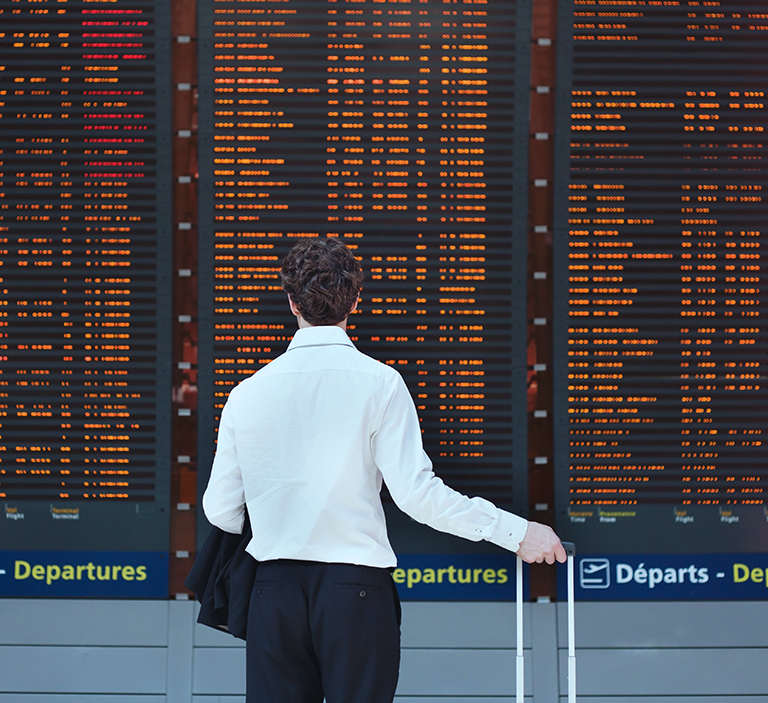
In contemporary business discourse, fatigue from business travel is often framed as a personal issue of resilience or adaptability. In reality, however, travel fatigue is not an individual problem. It is the result of systemic choices, poor organization, and insufficient managerial foresight. When an employee becomes exhausted from travel, the issue does not lie in their endurance, but in how the organization designs and manages the trip.
Fatigue as an Operational Failure
Travel fatigue does not appear suddenly. It accumulates through poorly designed itineraries, overly dense schedules, inadequate rest margins, and constant disruptions that the traveler is expected to handle alone. This accumulation affects not only physical stamina but also cognitive function. Reduced concentration, a greater likelihood of poor decision-making, and a decline in strategic sharpness are direct consequences of ineffective travel management.
Τεχνητή Νοημοσύνη στα Επαγγελματικά Ταξίδια
From Fatigue to Poor Decisions
In high-responsibility roles, the quality of decisions is critical. When an executive travels under conditions of continuous pressure and lack of predictability, mental fatigue transfers directly into decision-making. The outcome is not always immediately visible, but it manifests in delays, increased risk, missed opportunities, and strategic errors. These errors are rarely attributed to travel, even though they often originate there.

The Hidden Cost That Does Not Appear on Balance Sheets
Most organizations measure the cost of business travel based on tickets, accommodation, and expenses. The real cost, however, lies elsewhere. It is found in reduced performance, the need to repeat meetings, the erosion of judgment, and ultimately, the departure of experienced executives. Travel fatigue acts as a cost multiplier, affecting productivity and team cohesion without being formally recorded as such.
Why This Is Clearly a Management Issue
Travel fatigue cannot be addressed through individual guidelines or wellness advice. It requires managerial maturity and strategic thinking. How trips are designed, how realistic schedules are, whether clear boundaries exist, and whether the organization absorbs disruptions instead of transferring them to the employee are management decisions. When these decisions are flawed or absent, fatigue is inevitable.
The Role of Travel Management in Reducing Fatigue
Modern travel management is not limited to executing bookings. It functions as a balancing mechanism between operational demands and human capacity. Anticipation, flexibility, the avoidance of unnecessary travel, and the reduction of friction are not perks. They are tools for protecting performance. The more mature the travel management approach, the lower the likelihood that travel will become a source of wear and erosion.
Mideast’s Approach to Operational Resilience
Mideast views travel fatigue as an indicator of organizational resilience. Through structured policies, predictive management, and the removal of unnecessary complexity, it helps organizations protect the performance of their people. When travel is designed correctly, it does not test human limits, but supports the role itself.
In an environment of increasing pressure and speed, the real challenge is not to make people endure more, but to design organizations more intelligently. And it is there that travel fatigue ceases to be a personal issue and is revealed for what it truly is: a management problem.



Comment (0)